
- Table of Contents
- Introduction
- 1. What Longevity Means for the Structure of Careers
- 2. The End of the Three-Stage Model
- 3. Financial Planning Across an Extended Working Life
- 4. Reskilling and the Challenge of Continuous Learning
- 6. Mental Health and Wellbeing Across a Long Career
- 7. Multi-Generational Workplaces
- 8. Phased Retirement and the Transition Out of Full-Time Work
- 9. Policy Implications of Longer Working Lives
- 10. How Individuals Can Begin Preparing Now
- Conclusion
Introduction
The architecture of working life is being fundamentally redesigned. For most of the twentieth century, careers followed a predictable three-stage model: a period of education in early life, four decades of employment, and then retirement. That structure was built around a world in which most people could expect to live into their mid-seventies at best, and in which a single qualification earned in early adulthood could reasonably sustain a person through to a standard retirement age. Both of those conditions have changed, and the career model built upon them is no longer fit for purpose.
Global life expectancy has risen steadily and significantly over the past century. People are not only living longer but remaining in better health for more of their later years, which means that the prospect of remaining professionally active well into one's sixties, seventies, or even eighties is becoming a realistic horizon for a growing share of the workforce. This is not merely a demographic curiosity. It carries profound consequences for how individuals plan their careers, how organisations design their workforces, and how governments structure the labour markets and pension systems that underpin working life.
A 60-year work life is no longer a hypothetical. For many people entering the workforce today, it is a plausible projection. Someone beginning their career at 22 and remaining professionally active until their early eighties — whether in full-time employment, freelance work, consultancy, or phased engagement — faces a professional lifespan that the traditional career model was never designed to accommodate. They will need to reskill multiple times, navigate several distinct career phases, sustain their health and motivation across decades, and plan for a retirement that may itself last as long as an earlier generation's entire working life.
The gap between this reality and the institutions and assumptions that still govern most careers is one of the defining challenges of our time. Education systems remain largely front-loaded, pension structures were calibrated for shorter retirements, and many organisations continue to manage talent as though careers still end neatly at sixty-five. Closing that gap requires action at every level — from the individual professional rethinking their long-term development strategy, to the employer redesigning its talent model, to the policymaker updating the regulatory frameworks that shape when and how people work.
1. What Longevity Means for the Structure of Careers
The most immediate and concrete consequence of rising life expectancy is a longer working life. This is not simply a matter of staying in a job for longer. It involves rethinking the entire structure of professional development, from when learning happens, to how often people change direction, to how they maintain financial security across multiple decades of working life.
The demographic shift is already visible in labour market data. According to the OECD Employment Outlook 2025, the employment rate among people aged 45 to 64 rose by 9.3 percentage points on average across OECD countries between 2000 and 2024. This reflects the fact that people are not only living longer but staying healthier for longer, and that many are willing and able to remain in work well beyond what previous generations would have considered the standard retirement age.
This demographic reality has not yet been fully absorbed by the institutions and systems that shape working life. Most pension systems, career development frameworks, and organisational talent management approaches were designed around a 40-year working life, with the implicit assumption that skills and qualifications acquired in early adulthood would remain broadly adequate until retirement. That assumption is no longer tenable.
2. The End of the Three-Stage Model
For most of the twentieth century, the standard pattern of a working life was straightforward: education, work, retirement. This model was not only descriptively accurate for most people in developed economies; it was also the implicit framework around which educational systems, pension schemes, and career development practices were organised. It divided life into three distinct phases, each with a relatively clear beginning and end.
Lynda Gratton and Andrew Scott, in their influential work on longevity and careers, have argued that this three-stage model is becoming obsolete, replaced by a multi-stage model in which individuals move in and out of different kinds of work, learning, and rest across a much longer life. This has significant consequences: individuals can no longer expect a single qualification and a single employer or sector to carry them through their entire working life.
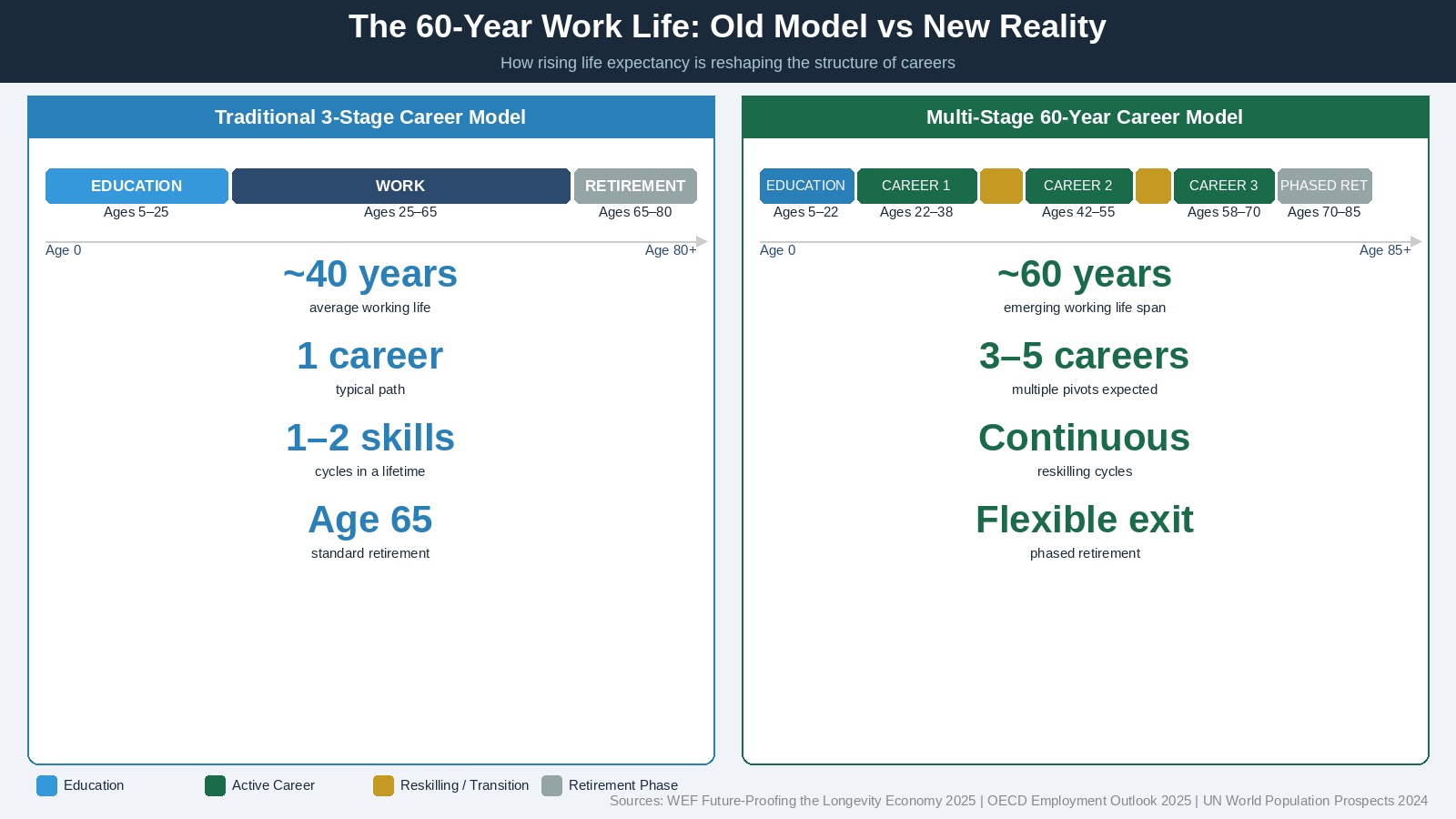
The practical implications of this shift are substantial. In a multi-stage career, individuals need different things from education at different points in their lives: foundational learning in early adulthood, technical upskilling during mid-career transitions, leadership and strategic development in later career phases, and perhaps entirely new vocational learning when entering a third or fourth professional chapter. The institutions and providers that support this kind of learning need to be correspondingly flexible and diverse.
3. Financial Planning Across an Extended Working Life
One of the most pressing practical challenges of a 60-year work life is financial. The traditional three-stage model assumed a relatively compact working life in which contributions to a pension fund, accumulated over forty years of employment, would support a retirement of perhaps fifteen to twenty years. A 60-year career fundamentally changes those calculations, but it also changes the risks.
The OECD's 2025 edition of Pensions at a Glance highlights that in 2024, women aged 65 could expect to live on average until age 86.6, and men until age 83.5. In some countries, women can expect more than 26 years of life after exiting the labour market. These figures have profound implications for retirement savings, with people needing to fund a retirement that could last as long as a previous generation's entire working life.
The World Economic Forum has noted that nearly 40 per cent of people globally face financial instability after unplanned career interruptions, including breaks for illness, caregiving, or unexpected redundancy. This risk is amplified over a 60-year career, which is more likely to include multiple such interruptions. Financial planning must therefore account not only for the accumulation of retirement savings, but for the likelihood of non-linear career paths that include gaps, pivots, and periods of reduced income.
Effective financial planning across an extended working life requires thinking about savings not as a linear accumulation towards a fixed retirement date, but as a dynamic resource that must be managed across multiple career phases. This includes planning for periods of reskilling or retraining, which may involve reduced earnings, for mid-career breaks, and for a phased transition out of full-time employment rather than an abrupt retirement. Individuals with access to flexible pension structures and diversified income sources will be significantly better placed to navigate these challenges.
Financial Dimension | Traditional 40-Year Career | Extended 60-Year Career |
|---|---|---|
Savings horizon | Accumulation over ~40 years | Accumulation over ~55–60 years |
Career interruptions | Fewer expected; lower financial risk | Multiple likely; higher planning needed |
Retirement funding | Fund ~15–20 years of retirement | Fund 25–30+ years of retirement |
Pension structure | Defined benefit or linear savings | Flexible, diversified, multi-source |
Reskilling costs | Minimal; one qualification phase | Recurring investment in learning |
Income trajectory | Largely linear growth | Variable across multiple career stages |
4. Reskilling and the Challenge of Continuous Learning
If there is a single professional capability that defines the requirements of a 60-year work life, it is the ability to learn, unlearn, and relearn across decades. The pace of technological change, particularly in artificial intelligence, data systems, and digital platforms, means that the specific skills required in any given role can become obsolete within years. A professional entering the workforce today cannot reasonably assume that the technical skills they develop in their twenties will remain adequate through their sixties.
The World Economic Forum's Future of Jobs Report 2025 estimates that 39 per cent of workers' existing skill sets will be transformed or become outdated between 2025 and 2030, and that 59 out of every 100 workers will need some form of retraining by 2030. These figures apply to a five-year window. Across a 60-year career, the cumulative scale of required reskilling is far greater.
Yet the OECD Employment Outlook 2025 reveals a troubling pattern: in 2023, only a third of adults aged 60 to 65 participated in any form of training, compared to more than half of those aged 25 to 44. This training participation gap has direct consequences for the employability of older workers, and it reflects a structural problem in how organisations and individuals approach learning across a long career. If reskilling is treated as something that happens early in a career and then stops, the result is a progressive divergence between the capabilities of older workers and the demands of the labour market.
Organisations also have a central role in enabling continuous reskilling. Holistique Training's Employee Training, Development and Empowerment course highlights that forward-thinking organisations recognise empowering employees to make workplace changes and assess risks allows them to take ownership of their development. Research embedded in this approach shows that employees given autonomy put in more effort, train others naturally, and generate continuous departmental improvement — outcomes that are especially valuable across a long career.

Many forward-thinking business owners realise that simply giving orders isn't the most effective way to get work done. Research shows that employees are more motivated and productive when they are free to make their own choices and follow paths they enjoy.
5. The Role of Employers and Organisations
Employers are not passive observers of the demographic shift towards longer careers. They are among its principal beneficiaries and its principal enablers. Organisations that adapt their talent management practices to support employees across longer, more varied career arcs will be better positioned to retain experienced staff, reduce costly turnover, and benefit from the depth of institutional knowledge that long-tenured employees bring. Those that fail to adapt risk losing experienced talent prematurely and struggling to fill the resulting gaps.
The OECD Employment Outlook 2025 identifies employer behaviour as a critical factor in the longevity challenge, noting that despite rising employment rates among older workers, employers often hesitate to hire or retain older workers due to age stereotypes around adaptability, productivity, or the need for workplace accommodations. Addressing these biases is not only ethically important but economically necessary. As working-age populations shrink in many OECD countries, the untapped potential of experienced older workers represents a significant resource.
Effective organisational responses to longer careers include investing in mentoring and reverse mentoring programmes , in which younger employees share digital skills whilst more experienced colleagues share strategic and relational knowledge; designing flexible working arrangements that accommodate different life circumstances at different career stages; and embedding continuous learning as a cultural expectation rather than a one-off intervention.
The "Human Resources Lifecycle Training: Mastering the Employee Journey" course provides a comprehensive understanding of the HR lifecycle and its critical role in shaping organisational success. Covering every stage of the employee experience—from recruitment to offboarding—this training equips HR professionals with the knowledge and tools
Organisational Practice | Short-Term Career Focus | Long-Career Inclusive Approach |
|---|---|---|
Talent development | Early-career investment only | Continuous development at all stages |
Learning culture | Compliance-driven training | Autonomous, embedded lifelong learning |
Performance management | Annual review cycles | Ongoing feedback and coaching |
Age management | Retirement planning for older workers | Active role design for all age groups |
Succession planning | Replacement-focused | Pipeline and knowledge transfer focused |
6. Mental Health and Wellbeing Across a Long Career
A 60-year work life is not only a financial and professional challenge. It is a deeply personal one. Sustaining engagement, motivation, and mental wellbeing across six decades of professional life requires intentional effort, structural support, and a realistic understanding of how energy, priorities, and identity shift across the life course. Burnout, stagnation, and loss of purpose are risks at any career stage, but they take on a different character when careers last significantly longer than previous generations anticipated.
Workplaces that support mental wellbeing across a long career typically share several features: they offer meaningful work at every stage rather than reducing older employees to narrowly defined roles; they support breaks, sabbaticals, and phased transitions rather than demanding unbroken linear engagement; and they invest in managerial capability to recognise and respond to signs of burnout or disengagement. The physical dimension of long careers is equally important, with ergonomic design, flexible hours, and health support all contributing to sustaining productivity and engagement across decades.
Purpose is also a central factor. Research consistently shows that people who experience their work as purposeful remain more engaged and productive for longer, and that a loss of purpose is associated with a desire for early exit from the workforce. Helping employees find and sustain a sense of purpose across the multiple transitions of a long career is therefore not simply a welfare consideration — it is a strategic organisational priority.
7. Multi-Generational Workplaces
One of the most visible and immediate consequences of longer working lives is the emergence of genuinely multi-generational workplaces. It is now common for organisations to have employees spanning four and sometimes five generations, from those in their early twenties entering the workforce for the first time, to people in their sixties and seventies whose experience and institutional knowledge are deeply embedded in the organisation's culture and operations.
Managing this kind of generational diversity is a genuine leadership challenge. Different cohorts may have markedly different expectations about technology, communication styles, authority structures, work-life boundaries, and career development. A 25-year-old who has grown up with digital platforms as native tools will approach work differently from a 60-year-old whose foundational professional skills were built in an analogue environment. Neither perspective is inherently superior, but managing the tension between them productively requires deliberate effort.
The most productive multi-generational environments are typically those that create structured opportunities for knowledge exchange across age groups. Reverse mentoring programmes, in which younger employees share digital expertise with senior colleagues whilst receiving guidance on strategic thinking and relationship management in return, are among the most effective tools for harnessing generational diversity. Intergenerational project teams, structured peer learning, and collaborative problem-solving all contribute to environments in which longevity becomes an organisational asset rather than a management challenge.
8. Phased Retirement and the Transition Out of Full-Time Work
The concept of retirement is itself being transformed by longevity. The traditional model of a hard stop at a defined age — leaving full-time employment and transitioning immediately and completely into retirement — is increasingly misaligned with the realities of longer, healthier lives. Many people who might previously have retired at 65 or 67 are not ready, financially or personally, to disengage entirely from professional life. And many organisations are discovering that they cannot afford to lose the institutional knowledge and expertise that long-tenured employees hold.
Phased retirement, which involves a gradual reduction in working hours and responsibilities over a period of years rather than an abrupt exit, is increasingly recognised as a more sustainable and humane model. It allows individuals to maintain engagement, income, and purpose whilst reducing the physical and cognitive demands of full-time work. For organisations, it enables knowledge transfer and succession planning to occur in a structured, unhurried way rather than under the pressure of a sudden departure.
Yet the barriers to extending working lives remain substantial. Research cited by the World Economic Forum estimates that an estimated 76 per cent of employees have experienced age discrimination at work, and that 25 per cent of people aged 55 or older encounter active barriers to finding employment opportunities. These figures reveal that the transition to longer careers is being undermined not only by structural inadequacies in pension and policy design, but by deeply embedded cultural attitudes that treat older workers as a liability rather than an asset. Overcoming those attitudes is as important a task as any technical reform of retirement policy.
The design of phased retirement models requires attention to several practical dimensions: how pension contributions and drawdown interact with part-time earnings; how benefits and employment protections apply to phased arrangements; how performance expectations and role responsibilities are adjusted during the transition phase; and how organisations support the emotional and psychological aspects of stepping back from a role that may have been a central source of identity for decades.
9. Policy Implications of Longer Working Lives
The challenge of preparing individuals and organisations for 60-year careers is not one that individuals and employers can resolve on their own. It requires coordinated policy responses at national and international levels, addressing pension system design, labour market regulation, education and training infrastructure, age discrimination law, and health system capacity.
Pension systems face the most immediate structural pressure. Systems designed around the assumption that the average person would retire at 65 and live for fifteen further years are under strain when the average retirement lasts twenty to twenty-five years, and when a growing proportion of the population remains in good health and is willing and able to work well into their seventies. The OECD has noted that, based on current legislation, retirement ages will increase by about two years for those now entering the workforce, but acknowledges that this adjustment falls far short of what demographic projections actually require.
Education and training policy faces equally significant challenges. A world in which individuals need to reskill multiple times across a 60-year career requires an education system that extends well beyond the front-loaded model of initial schooling and university education. UNESCO has argued that flexible learning pathways, including short credentials, modular qualifications, and employer-led training, need to become regular features of national education and training systems rather than peripheral supplements.
Age discrimination in employment is a systemic barrier that policy must address directly. Employers who make hiring and retention decisions based on age stereotypes — assuming that older workers are less adaptable, less productive, or less worth investing in — are acting both unlawfully in most jurisdictions and, according to OECD evidence, incorrectly. Enforcement of age discrimination protections, combined with employer incentives for investing in older worker training, are among the most direct policy levers available.
Policy Area | Current Approach | Required Adaptation for 60-Year Careers |
|---|---|---|
Pension systems | Fixed retirement ages (65–67) | Flexible, phased, and portable pension structures |
Education | Front-loaded school and university | Lifelong learning infrastructure and credentials |
Labour law | Age discrimination protections exist | Active enforcement and employer incentives |
Health systems | Treatment-focused | Preventive care and workforce health promotion |
Skills policy | Short-term employer needs focus | Long-term reskilling infrastructure |
10. How Individuals Can Begin Preparing Now
Whilst systemic and organisational change is necessary, individuals also have significant agency in how they navigate a 60-year work life. The most resilient and fulfilled professionals of the coming decades will be those who approach their careers not as a single linear journey but as a series of chapters, each with its own learning requirements, purpose, and trajectory.
The starting point is a fundamental shift in mindset: from treating education as something that happens once, early in life, and then stops, to treating learning as a continuous, career-long practice. This does not mean perpetual formal study. It means cultivating curiosity, staying alert to how the skills required in one's field are changing, and being willing to invest time and sometimes money in acquiring new capabilities before they become urgently necessary.
Building a portable, transferable skills base is equally important. Professionals who develop strong capabilities in areas that span multiple sectors — communication, data literacy, project management, emotional intelligence, strategic thinking — are significantly more resilient to sectoral disruption than those whose expertise is narrowly technical or role-specific. Investing in these cross-cutting capabilities is a form of career insurance against the inevitable shifts that a 60-year work life will involve.

In today's fast-paced corporate landscape, leaders often grapple with overwhelming responsibilities amidst the ever-evolving VUCA challenges - Volatility, Uncertainty, Complexity, and Ambiguity. This course offers a candid exploration of leadership strategies essential for navigating through turbulent times. Participants will learn to cultivate empathetic behaviours, prioritise
Financial planning deserves particular attention. Many people continue to defer serious engagement with long-term financial planning, treating retirement savings as something to address in mid-career. For those facing a 60-year work life, this deferral is increasingly costly. The compounding value of early savings, the unpredictability of career interruptions, and the sheer length of the retirement that must be funded all argue for engaging with financial planning from the earliest years of a career.
Building and maintaining professional networks is another critical long-career practice. Networks that span multiple sectors, generations, and disciplines provide access to opportunities, intelligence about emerging skill demands, and support during the transitions and disruptions that an extended career will inevitably involve. The World Economic Forum has noted that community connections are critical to wellbeing in later working life, and that those who maintain strong professional and social networks tend to have both longer and more satisfying careers.
Finally, taking a deliberate approach to purpose is essential. A 60-year career that is driven purely by external pressure — by the need to earn, to accumulate, or to meet others' expectations — is unlikely to be sustainable or fulfilling. The most durable professional lives are typically those shaped by a clear sense of what the individual values, what contribution they wish to make, and how their work aligns with the kind of life they want to live. Revisiting and refreshing this sense of purpose at each major career transition is one of the most important habits a long-career professional can develop.
Conclusion
A 60-year work life is not a distant hypothetical. It is the emerging reality for a generation entering the workforce today in a world where life expectancy continues to rise, where the skills required in any given role can become obsolete within years, and where the traditional three-stage career model is structurally inadequate for the lives that most people will actually live.
Preparing for this reality requires action at every level. Individuals need to adopt a lifelong learning mindset, build portable and transferable skills, plan their finances for a much longer and less predictable career arc, and approach purpose and wellbeing as career-long practices rather than retirement considerations. Organisations need to invest in multi-generational talent management, continuous learning cultures, flexible working arrangements, and age-inclusive hiring practices. Policymakers need to redesign pension systems, education infrastructure, and labour market regulation for a world of longer, more complex working lives.
The challenges are real and significant. But so are the opportunities. A world in which people remain active, engaged, and purposeful in their professional lives well into their seventies and eighties is not simply a world of longer careers. It is a world of richer intergenerational exchange, deeper accumulated expertise, and greater individual fulfilment across a longer and more fully lived adult life. Getting there requires the kind of deliberate, forward-looking preparation that this article has set out to support. The 60-year work life is coming — and those who prepare for it thoughtfully will be the ones who thrive within it.