
- Table of Contents
- Introduction
- 1- Who Are Older Workers and Why Does This Matter Now?
- 2- Understanding Upskilling: Building on What Is Already There
- 3- Understanding Reskilling: Learning for a Different Future
- Upskilling vs Reskilling: A Comparison
- 4- Career Transitions: Navigating a Professional Pivot
- 5- The Role of Employers in Supporting Older Workers
- Common Employer Approaches to Supporting Older Worker Development
- 6- Barriers to Upskilling, Reskilling, and Transition
- 7- Technology, AI, and the Specific Challenges for Older Workers
- 8- Policy, Institutions, and the Wider Support Landscape
- 9- Practical Strategies for Older Workers
- Effective Development Approaches by Transition Type
- 10- Lifelong Learning as the Foundation
- Conclusion
Introduction
The composition of the global workforce is changing in ways that cannot be ignored. People are living and working longer, retirement ages are rising in many countries, and organisations across every sector are grappling with the reality that a significant portion of their workforce is over the age of 50. At the same time, technological change is accelerating, labour markets are being restructured by automation and artificial intelligence, and the skills required across almost every profession are shifting faster than they have at any previous point in modern history. The convergence of these forces has placed older workers at the centre of one of the most pressing challenges in contemporary employment: how to remain relevant, competitive, and fulfilled in careers that may still span a decade or more.
This article addresses that challenge across three interconnected dimensions. The first is upskilling, which involves building on existing capabilities to strengthen performance and adapt to changing role requirements. The second is reskilling, which involves acquiring new capabilities to move into different roles or sectors entirely. The third is career transition, which encompasses the broader process by which older workers reposition themselves professionally, whether voluntarily or in response to external pressures. Together, these three themes reflect the practical realities facing millions of workers and the organisations that employ them.
The aim of this article is to provide a grounded and balanced view of all three dimensions, drawing on current research and workforce data. It is written for a general professional audience, whether you are an older worker navigating these questions personally, a manager supporting colleagues through change, or an HR professional designing programmes for a multigenerational workforce.
1- Who Are Older Workers and Why Does This Matter Now?
The term older worker is used broadly in labour market research to describe individuals aged 50 and above, though some frameworks extend this to 45 or narrow it to 55. What matters more than the precise cut-off is the scale. In England, employment among 50 to 64-year-olds has increased by 40 per cent over the past 20 years, which is nearly three times faster than overall employment growth during the same period, according to analysis by the CIPD. Across the wider Organisation for Economic Co-operation and Development (OECD), populations are ageing rapidly, and policymakers in numerous countries are raising the state pension age in response. For employers, this creates both an imperative and an opportunity. The imperative is that organisations must find ways to develop, retain, and effectively deploy workers who will remain active in the workforce for significantly longer than previous generations. The opportunity is that experienced workers represent an enormous reservoir of accumulated knowledge, professional skill, and institutional understanding.
Despite this, older workers face structural disadvantages that have become more acute in recent years. The CIPD warns that they are particularly exposed to the megatrends reshaping the labour market, from rapid advances in AI to the transition to a net zero economy. With fewer opportunities to develop, retrain, or switch careers, many risk being left behind as roles evolve or disappear entirely. These concerns are borne out in workforce participation data: following the COVID-19 pandemic, there were 228,000 more people aged 50 to 64 economically inactive in the United Kingdom than there were before the pandemic, according to the Centre for Ageing Better. The challenge is therefore structural, not merely personal.
2- Understanding Upskilling: Building on What Is Already There
Upskilling refers to the process of developing and enhancing skills within a worker's existing domain. For an older worker who has spent years in a professional role, upskilling is not about starting again. It is about evolving, updating, and deepening capabilities in response to how that role is changing. This might mean learning to use new digital tools, developing familiarity with data analysis methods, or strengthening leadership and communication skills as organisations restructure. The logic of upskilling is pragmatic: it is generally faster and less disruptive than reskilling because it builds on a foundation that is already in place.
One of the most persistent misconceptions about older workers and upskilling is that they are resistant to new skills or incapable of learning them. Research does not support this view. According to findings published by SHRM, 74 per cent of older workers who are employed by an organisation are willing or very willing to participate in AI upskilling initiatives if they are offered. Even more significantly, 81 per cent of older workers feel confident in their ability to learn and adapt to new workplace technologies. The gap between perception and reality is stark: nearly half of HR professionals surveyed believed older workers in their organisation were unwilling to engage with AI training, despite the evidence to the contrary. Closing this perception gap is itself a crucial step towards building effective upskilling programmes.
The most effective approaches to upskilling older workers are often those that are also effective for the wider workforce. On-the-job training, clear job aids, bite-sized digital modules, and mentoring arrangements all perform well. What matters most is that training is relevant to the worker's current responsibilities and is designed to be applied immediately. Abstract or generic learning that has no obvious connection to day-to-day tasks is less effective for any age group, but the disconnect is often felt more keenly by experienced workers who are accustomed to practically grounded professional development.
3- Understanding Reskilling: Learning for a Different Future
Reskilling is more substantial in scope than upskilling. It involves acquiring a new set of capabilities in order to move into a different role, function, or sector. For an older worker, reskilling might mean transitioning from a manual trade to a supervisory or training role, moving from administrative work into digital services, or pivoting from a declining industry into a growing one. The catalyst for reskilling is often external: automation, organisational restructuring, sector contraction, or the disappearance of a specific role. But it can also be internally motivated, driven by a desire for greater fulfilment, better conditions, or a more sustainable working life in the years ahead.
The scale of reskilling need across the global workforce is significant. According to the World Economic Forum's Future of Jobs Report, 59 out of every 100 workers will require training by 2030, and workers can expect 39 per cent of their existing skill sets to be transformed or rendered outdated between 2025 and 2030. These figures apply across age groups, but they carry particular weight for older workers who have fewer remaining years to absorb the costs of an extended transition and whose prior qualifications may not be aligned with emerging roles.
Reskilling for older workers also raises particular questions about how learning is structured. Large-scale retraining programmes that require workers to disengage from employment for extended periods are often impractical for people with financial commitments and family responsibilities. The CIPD has called for governments to consider training vouchers, flexible individual learning accounts, and paid educational leave as mechanisms for enabling reskilling without full income loss. Shorter, more modular pathways, including micro-credentials and stackable qualifications, are increasingly being advocated as more accessible and realistic options. Approaches such as returnships, apprenticeships adapted for mature learners, and job-sharing arrangements have also been identified by the World Economic Forum as strategies that should be scaled.
Upskilling vs Reskilling: A Comparison
Dimension | Upskilling | Reskilling |
Focus | Deepening and enhancing existing skills | Acquiring new skills for a different role |
Disruption Level | Lower — builds on existing role | Higher — may require significant change |
Time Required | Short to medium term | Medium to long term |
Typical Trigger | Technology change, role evolution | Role redundancy, sector decline, voluntary pivot |
Who Benefits Most | Workers adapting to changing roles | Workers changing sector or function |
Common Formats | Short courses, on-the-job training | Formal programmes, micro-credentials, apprenticeships |
Both upskilling and reskilling are more effective when they are supported by employers rather than left entirely to individual initiative. An older worker pursuing reskilling independently, without institutional support or financial assistance, faces considerable barriers. Organisations that invest proactively in structured development pathways not only benefit from more capable and adaptable employees, but also signal a commitment to inclusive workforce planning that strengthens retention and morale across all age groups.

The 21st century demands more than just subject knowledge — learners need a set of future skills to thrive in an ever-changing, technology-driven, and interconnected world. These skills — often called “soft” or “essential” — include creativity, critical thinking, digital literacy, collaboration, and resilience.This course equips
4- Career Transitions: Navigating a Professional Pivot
Career transitions refer to the broader process of repositioning oneself professionally. This may involve a complete change of sector, a shift to a different functional role, a move from employment into self-employment, or a staged withdrawal from full-time work towards part-time or consultancy arrangements. For older workers, transitions often carry emotional as well as practical weight. A person who has spent decades building expertise and identity within a particular field may find it genuinely disorienting to step outside it. At the same time, many older workers who do make successful transitions report significantly higher levels of satisfaction in their new roles.
The timeline below illustrates the key stages that typically characterise a career transition for an older worker, from the initial trigger event through to re-establishment in a new professional context. It is important to note that these stages are not always linear, and many individuals will move between them more than once.
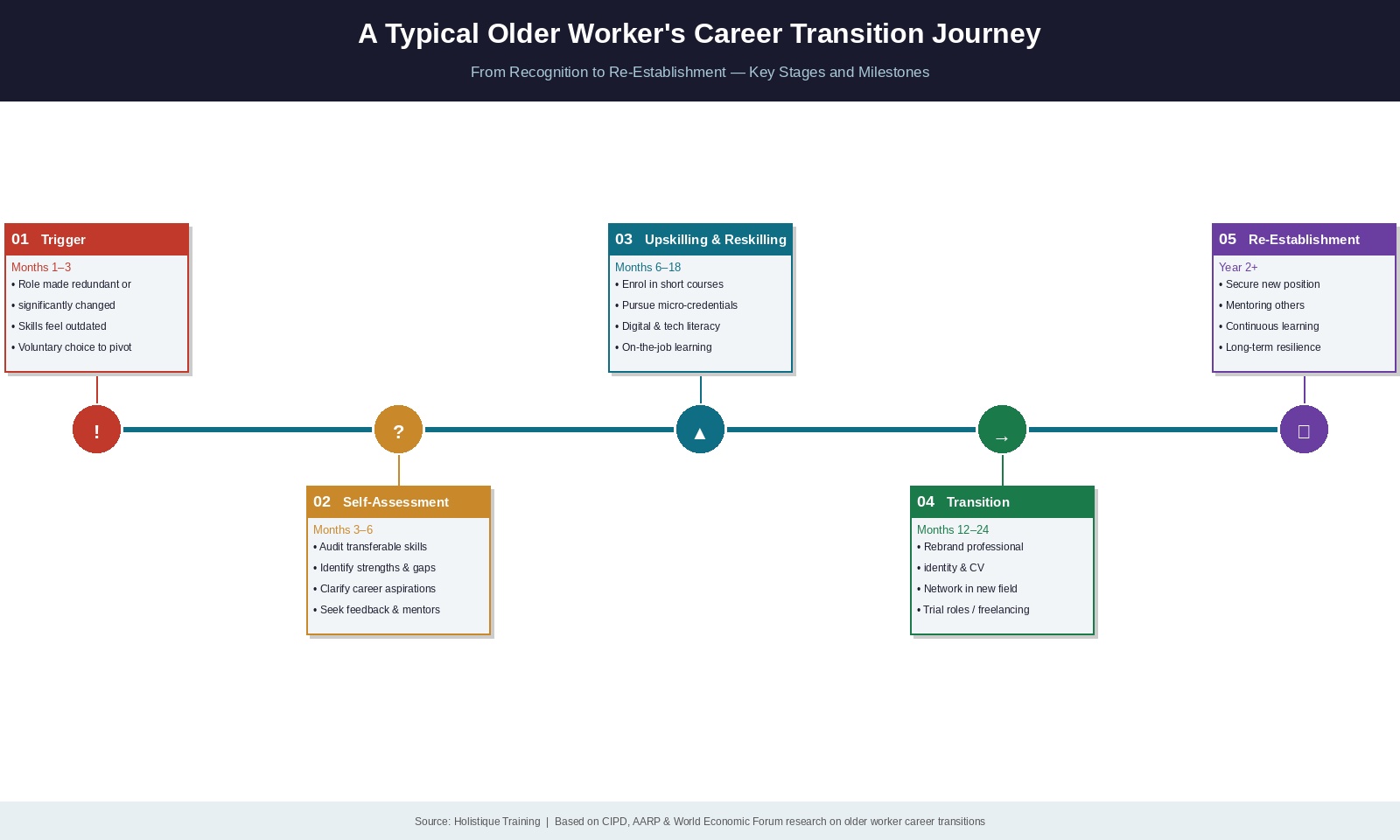
A career transition typically begins with a trigger, which may be voluntary or involuntary. Involuntary triggers include redundancy, organisational restructuring, the automation of a role, or health changes that make a previous occupation unsustainable. Voluntary triggers include a desire for greater fulfilment, a reassessment of priorities following a life event, or a long-held ambition to work in a different field. Both types of trigger require similar processes of reflection, planning, and action, though the emotional starting point may differ considerably. Workers who choose to transition tend to have more time to prepare, while those pushed into transition involuntarily often need to move more quickly and may require more support.
Self-assessment is the foundation of any effective career transition. Understanding what skills are transferable, what gaps need to be addressed, and what kind of work is likely to generate lasting engagement matters more than any specific credential or qualification. Older workers tend to possess a broader range of soft skills and cross-functional experience than is often recognised, including leadership, stakeholder management, mentoring, project management, and the capacity to operate effectively under pressure. These capabilities have genuine market value and should be explicitly identified and articulated rather than assumed to be self-evident.

Feeling stuck or unfulfilled at work? Discover the key signs it’s time for a career change—like burnout, stalled growth, and shifting values—and how to take action.
5- The Role of Employers in Supporting Older Workers
Employers occupy a central position in the landscape of older worker development. Whether older workers can successfully upskill, reskill, or transition often depends more on what organisations do than on what individuals choose. This is not simply a matter of goodwill. There is a strong commercial case for investing in the development of older employees. Experienced workers who are well-supported are more loyal, more productive, and better able to share institutional knowledge with younger colleagues. High turnover among experienced staff is costly, and in industries where specialised expertise takes years to develop, losing older workers prematurely represents a significant operational risk.
Despite this, many organisations fall short of what is needed. According to SHRM research, only 12 per cent of organisations offer upskilling and reskilling opportunities specifically designed for older workers, and just 21 per cent actively challenge age stereotypes to foster an inclusive workplace culture. This disconnect between what older workers need and what is actually on offer is a significant and largely unaddressed gap in talent management practice. Closing it requires not only investment in training programmes but also a deliberate effort to examine the assumptions, policies, and cultural norms that can disadvantage older workers even in organisations that consider themselves inclusive.
Common Employer Approaches to Supporting Older Worker Development
Approach | Description | Effectiveness |
Mentoring & reverse mentoring | Pairing older workers with younger colleagues for mutual knowledge exchange | High |
Flexible working arrangements | Part-time, remote, or job-share options to accommodate changing needs | High |
Short modular training | Bite-sized, role-relevant courses that fit around work schedules | High |
Returnship programmes | Structured re-entry pathways for workers returning after a career break | Medium-High |
Career coaching | One-to-one support to help workers identify goals and plan transitions | High |
Age-inclusive recruitment | Removing age-related bias from hiring and promotion processes | Medium |
The "Human Resources Lifecycle Training: Mastering the Employee Journey" course provides a comprehensive understanding of the HR lifecycle and its critical role in shaping organisational success. Covering every stage of the employee experience—from recruitment to offboarding—this training equips HR professionals with the knowledge and tools
6- Barriers to Upskilling, Reskilling, and Transition
Understanding the barriers that older workers face is essential to designing interventions that actually work. These barriers operate at multiple levels simultaneously. At the individual level, they include concerns about the relevance of available training, uncertainty about which skills are most worth pursuing, financial constraints, and, in some cases, reduced confidence following a period of professional disruption. A survey commissioned by the UK government body Skills for Life found that 44 per cent of adults reported that discovering a course or topic that genuinely inspires them would restore their confidence, and one in three reported remaining curious about their untapped potential. This suggests that motivation is not the primary problem: access and relevance are.
At the organisational level, barriers include managers who do not see value in investing in workers closer to retirement, training programmes designed primarily for early-career employees, and a lack of time allocation for development activities within already demanding schedules. At the systemic level, barriers include the cost of formal retraining, insufficient policy support, and the limited availability of qualifications that are stackable and portable across employers and sectors.
Digital access is also a significant and often underestimated barrier. Many reskilling and upskilling programmes are now delivered online, which assumes that learners have reliable access to appropriate devices and stable internet connections. For workers in lower-income brackets or in rural areas, this assumption is not always warranted. Designing for access, not just for content, is therefore an important dimension of any serious effort to widen participation in workforce development among older workers.
7- Technology, AI, and the Specific Challenges for Older Workers
Artificial intelligence and automation are reshaping work at a speed and scale that creates genuine challenges for older workers who did not grow up with digital tools as a central feature of their professional environment. This is not, as the previous section noted, because older workers are unwilling to engage with technology. It is because the learning curve associated with rapid digital transformation can be steep, and because access to appropriate support, time, and quality instruction is unevenly distributed. AI is affecting the content of jobs across almost every sector, requiring workers to interact with increasingly sophisticated systems, interpret data outputs, and make decisions informed by algorithmic tools.
For older workers who wish to remain competitive in this environment, digital and data literacy are becoming as essential as the functional skills of their profession. The World Economic Forum identifies AI, big data, and cybersecurity literacy among the fastest-growing skills globally. Organisations that proactively include older workers in their digital upskilling strategies, rather than assuming that this group is either unwilling or unable to engage, are better positioned to benefit from the full range of their workforce's capabilities. Importantly, the soft skills that older workers typically bring in abundance, including critical thinking, communication, ethical judgement, and the ability to contextualise information, are precisely the capabilities that AI cannot replicate and that organisations most need alongside technical proficiency.

The rise of artificial intelligence is reshaping how we think, learn, and solve problems. In today’s fast-changing world, learning is no longer a linear process—it’s a dynamic interaction between human insight and machine intelligence. This course introduces the concept of hybrid intelligence and empowers participants to
8- Policy, Institutions, and the Wider Support Landscape
Individual effort and organisational willingness alone are not sufficient to address the scale of the upskilling and reskilling challenge facing older workers. Policy frameworks at national and regional level play a critical role in shaping what is possible. The CIPD's 2025 analysis calls for a new era of reskilling and specifically advocates for training vouchers, flexible individual learning accounts, and paid educational leave as mechanisms that could significantly increase participation in workforce development among older workers. These interventions exist in various forms in a number of countries: Singapore's SkillsFuture programme, for instance, provides educational credits to all citizens regardless of age or starting point, and has been cited as a model of inclusive lifelong learning provision.
In the United Kingdom, the introduction of Skills England and various reforms to adult education funding represent steps in this direction, though the CIPD notes that participation in training falls with age and that spending on workforce training has declined by 27 per cent over the last ten years in real terms, dropping from approximately £4,095 per trainee in 2011 to £2,971 per trainee in 2022. This decline is particularly damaging for older workers, who are already disproportionately underserved by existing training infrastructure. Reversing this trend requires sustained policy commitment rather than short-term initiatives.
9- Practical Strategies for Older Workers
Whilst structural and organisational change is necessary, individual older workers also have agency in managing their own development and transitions. Several practical strategies are well-supported by evidence and real-world experience. The first is conducting a thorough personal skills audit. This involves not only cataloguing existing technical competencies but also identifying transferable skills, professional relationships, and areas of knowledge that may have broader market value than is immediately apparent. Many older workers underestimate the breadth of their experience and benefit considerably from structured reflection or coaching to make it visible.
The second strategy is to pursue targeted, modular learning rather than committing to lengthy formal programmes. Short courses, professional certifications, and online credentials that can be completed alongside employment are often more practical and just as effective as extended academic programmes. The growth of platforms offering flexible, professionally recognised qualifications has made this increasingly accessible. Networking with peers who have made similar transitions, or who work in fields being targeted, is also consistently identified as one of the most effective forms of career intelligence. Understanding what roles actually involve, what employers in a new sector value, and what pathways have worked for others provides information that no generic career guide can replicate.
Effective Development Approaches by Transition Type
Transition Type | Recommended Approaches | Key Considerations |
Staying in current role | Digital upskilling, leadership development, mentoring others | Align with employer's strategic direction |
Moving within same sector | Functional reskilling, professional certification, lateral networking | Leverage existing sector knowledge |
Changing sector entirely | Micro-credentials, returnships, portfolio building, career coaching | Identify transferable skills clearly |
Moving to self-employment | Business planning, client development, digital marketing, financial literacy | Ensure adequate savings runway for transition |
Phased retirement | Consultancy, part-time work, knowledge transfer roles | Negotiate flexible arrangements with employer |
10- Lifelong Learning as the Foundation
The concept of lifelong learning underpins all three of the themes in this article. Upskilling, reskilling, and career transitions are not discrete events that happen at a particular age. They are expressions of a more fundamental shift in how work, learning, and career development are structured across an entire working life. The idea that education is something that happens once, at the beginning of a career, and then stops has been superseded by the economic realities of the 21st century. Workers who treat learning as an ongoing practice, rather than an exceptional response to crisis, are better prepared for transitions when they come, more adaptable to change, and more likely to remain engaged and productive across a longer working life.
This requires a shift in mindset for individuals, for organisations, and for the institutions that design learning and development systems. For individuals, it means staying curious, maintaining professional networks, and being willing to occupy the role of learner at any career stage. For organisations, it means embedding development into the culture rather than treating it as a remedial intervention or a reward for high performers. For institutions, it means designing flexible, accessible, and stackable learning pathways that serve people across the full span of working life rather than primarily at its beginning.
Older workers who embrace this orientation tend to navigate transitions with greater resilience. They are more likely to have existing networks they can activate, more likely to have developed a broad portfolio of transferable skills, and more likely to view career change as a challenge to be engaged rather than a loss to be mourned. The evidence consistently shows that companies and economies that invest in the ongoing development of their entire workforce, including their older workers, perform better than those that do not. The case is simultaneously ethical, economic, and practical.
Conclusion
Older workers are not a problem to be managed. They are a resource to be developed. The challenges associated with upskilling, reskilling, and career transition are real, and they require genuine effort from individuals, organisations, and policymakers alike. But the barriers are not insurmountable, and the evidence from both research and practice is clear: older workers who are given appropriate support, relevant opportunities, and the time to learn are highly capable of adapting, contributing, and thriving. The ageing of the global workforce is not a temporary condition. It is a structural feature of the labour markets of the 21st century, and addressing it effectively is one of the most important workforce challenges of our time. The organisations, systems, and workers that approach it with creativity, inclusion, and a genuine commitment to lifelong learning will be the ones best placed to succeed.
To explore practical development pathways and training programmes designed to support career growth at any stage, subscribe to the Holistique Training newsletter and browse our portfolio of professional courses.