
- Table of Contents
- 1- Introduction:
- 2- Conceptual Foundations of Regenerative Business
- 1- Systems Thinking as a Core Framework
- 2- Ecological Economics and Value Redefinition
- 3- Biomimicry and Design Intelligence
- 3- Regenerative vs Traditional and Sustainable Models
- 4- Core Components of Regenerative Business Models
- 1- Circular and Bio-Based Design
- 2- Regenerative Supply Chains
- 3- Energy Systems Transformation
- 4- Waste as a Design Failure
- 5- Community Co-Creation and Local Value Systems
- 6- Stakeholder Integration and Systems Accountability
- 7- Multi-Capital Measurement and Value Recognition
- 5- Economic Rationale and Strategic Advantage
- 6- Implementation Strategies for Regenerative Transition
- 7- Challenges and Constraints
- 1- Measurement and Data Limitations
- 2- Financial and Investment Barriers
- 3- Capability and Knowledge Gaps
- 4- Regulatory and Institutional Constraints
- 5- Market and Behavioral Barriers
- 8- Future Outlook: Toward Regenerative Economies
- 9- Conclusion
1- Introduction:
For decades, sustainability has shaped how organizations approach environmental and social responsibility, driving improvements in emissions reduction, resource efficiency, and regulatory compliance. Despite these gains, sustainability remains inherently limited because it focuses on minimizing harm rather than reversing it. In a global context marked by climate instability, biodiversity loss, and widening socioeconomic inequalities, reducing negative impact is no longer sufficient. Businesses are increasingly required to rethink their role within broader systems rather than simply optimizing their internal operations.
Regenerative business models emerge as a response to this limitation by shifting the objective from harm reduction to system restoration. Instead of merely sustaining current conditions, these models aim to actively improve ecological and social systems. This involves aligning profitability with long-term environmental regeneration and community resilience, transforming businesses from extractive entities into contributors to systemic health.
The urgency of this shift is evident in global data. According to the Intergovernmental Panel on Climate Change (IPCC), global greenhouse gas emissions must decline by approximately 43% by 2030 to maintain a 1.5°C warming threshold. This requirement highlights that incremental sustainability improvements are insufficient and that systemic transformation is necessary across industries.
2- Conceptual Foundations of Regenerative Business
Regenerative business models are grounded in an integrated framework combining systems thinking, ecological economics, and biomimicry. These approaches collectively redefine how value is created and sustained, emphasizing interdependence rather than isolation. Businesses are no longer viewed as independent units but as embedded components within dynamic ecological and social systems.
1- Systems Thinking as a Core Framework
Systems thinking fundamentally shifts the analytical lens from isolated processes to interconnected relationships. Within this framework, organizations recognize that every operational decision generates ripple effects across supply chains, communities, and ecosystems. Feedback loops become central, as outputs from one stage of a process influence future inputs, enabling continuous adaptation and learning. This perspective allows businesses to anticipate unintended consequences, such as environmental degradation embedded within upstream activities or social inequities within labor practices. By prioritizing long-term equilibrium over short-term optimization, systems thinking encourages decisions that stabilize rather than destabilize the broader system, reducing the risk of externalized costs.
2- Ecological Economics and Value Redefinition
Ecological economics challenges traditional assumptions that treat natural resources as infinite or external to economic systems. In regenerative models, natural capital is recognized as finite and essential, requiring preservation and enhancement. Economic activity is therefore constrained by ecological limits, ensuring that production does not exceed the regenerative capacity of natural systems. This reframing expands the concept of value creation to include restoration activities, such as improving soil health or increasing biodiversity. As a result, profitability becomes aligned with ecological well-being, rather than achieved at its expense.
3- Biomimicry and Design Intelligence
Biomimicry introduces design principles inspired by natural systems, where efficiency, resilience, and adaptability are inherent. In these systems, waste does not exist, as outputs are continuously reintegrated into new processes. Regenerative businesses replicate this through closed-loop designs that eliminate waste and maximize resource utilization. Diversity is another critical principle, as varied systems are more resilient and capable of innovation. Similarly, decentralization enhances adaptability by enabling localized responses to changing conditions. Empirical evidence supports this approach; a study published in Nature Sustainability found that regenerative agricultural systems can improve soil health indicators by up to 30% while maintaining or increasing, demonstrating that ecological restoration can directly enhance productivity.
3- Regenerative vs Traditional and Sustainable Models
Dimension | Traditional Model | Sustainable Model | Regenerative Model |
Primary Objective | Profit maximization | Reduce negative impact | Create net-positive systems |
Resource Flow | Linear | Optimized linear | Circular and restorative |
Environmental Role | Externality | Managed risk | Core value driver |
Time Horizon | Short-term | Medium-term | Long-term systemic resilience |
The distinction be tween these models lies in their underlying logic, particularly in how they define value, manage resources, and interpret risk. Traditional models are built on a linear economic structure—extract, produce, consume, and dispose—where efficiency is often prioritized over long-term consequences. Within this framework, environmental and social costs are frequently externalized, meaning they are not accounted for in financial decision-making. This allows organizations to maximize short-term profitability, but at the expense of long-term system stability, leading to resource depletion, environmental degradation, and social imbalance.
Sustainable models emerged as a corrective mechanism to this approach, introducing the concept of minimizing harm. They focus on reducing emissions, improving energy efficiency, and ensuring more responsible sourcing practices. However, despite these improvements, sustainability often operates within the same structural boundaries as traditional models. Resource flows remain largely linear, and the primary objective is still centered on maintaining business continuity rather than transforming the system itself. In this sense, sustainability can be understood as an optimization strategy—it makes existing systems less harmful but does not fundamentally redesign them.
Regenerative models represent a more advanced stage of evolution by shifting from optimization to transformation. Instead of asking how to reduce negative impact, regenerative approaches ask how business activities can actively contribute to restoring and enhancing the systems they depend on. This introduces a fundamentally different logic of value creation. Environmental and social factors are no longer treated as constraints or risks to be managed, but as integral components of business success.
One of the most significant differences lies in resource flow. While traditional and sustainable models rely on linear or partially optimized systems, regenerative models adopt circular and restorative flows. Materials are continuously cycled, waste is designed out of the system, and natural processes are leveraged to regenerate resources. This reduces dependency on finite inputs and creates more resilient supply chains.
The role of the environment also shifts dramatically. In traditional models, the environment is an externality—something outside the boundaries of business operations. In sustainable models, it becomes a managed risk, requiring compliance and mitigation strategies. In regenerative models, however, the environment is repositioned as a core value driver. Healthy ecosystems are recognized as essential to long-term productivity, stability, and profitability, leading businesses to invest directly in their restoration.
Time horizon further differentiates these models. Traditional businesses operate on short-term financial cycles, often driven by quarterly performance metrics. Sustainable models extend this perspective slightly, incorporating medium-term goals such as emissions reduction targets. Regenerative models, by contrast, adopt a long-term systemic perspective, focusing on resilience, adaptability, and the sustained health of interconnected systems over time.
Ultimately, the transition from traditional to sustainable to regenerative models reflects a progression in business maturity. It moves from extraction to efficiency, and finally to restoration. Organizations that adopt regenerative models are not simply reducing their negative footprint—they are redefining their role within the economy, positioning themselves as active contributors to ecological and social well-being while maintaining economic viability.
4- Core Components of Regenerative Business Models
Regenerative business models are operationalized through a set of interconnected components that collectively enable system-level transformation. These components do not function independently; their effectiveness depends on how well they are integrated into a coherent system that aligns operational processes with ecological and social regeneration. Unlike traditional or even sustainable models, which often apply isolated improvements, regenerative models require simultaneous shifts across design, supply chains, governance, and performance measurement.
1- Circular and Bio-Based Design
Circular and bio-based design represents the foundation of regenerative systems. It moves beyond efficiency to fundamentally eliminate the concept of waste. Products are intentionally designed for long lifecycles, with modular structures that allow for repair, upgrading, and reuse. Materials are selected based on their ability to either re-enter industrial cycles or safely decompose within natural systems. This approach reduces dependence on virgin resources while also lowering long-term production costs and environmental impact. Over time, it enables organizations to transition from resource-intensive operations to self-sustaining material flows, increasing both resilience and efficiency.
2- Regenerative Supply Chains
Regenerative supply chains extend circular principles beyond the boundaries of the firm. Instead of focusing solely on compliance or ethical sourcing, companies actively invest in improving the ecosystems and communities that support their operations. This may include practices such as regenerative agriculture, water system restoration, or biodiversity enhancement within sourcing regions. By doing so, organizations shift from extractive relationships to restorative partnerships, ensuring long-term resource availability while strengthening local economies. This approach also reduces systemic risk, as healthier ecosystems are more stable and productive over time.
Area | Sustainable Approach | Regenerative Approach |
Supply Chains | Ethical sourcing | Ecosystem restoration |
Energy | Renewable adoption | Net-positive energy systems |
Waste | Reduction | Eliminated through design |
Community Impact | CSR initiatives | Co-created local value systems |
Supply Chain Management (SCM) is essential in any business to ensure you have a reliable supply of products, equipment, and tools to run your operation effectively. Managing a supply chain requires consideration of many factors to keep your business sustainable into the future and to
3- Energy Systems Transformation
Energy within regenerative models is not only renewable but net-positive. This means that businesses aim to generate more energy than they consume, contributing surplus energy back to the grid or local communities. This shift transforms energy from a cost center into a value-generating asset. It also enhances resilience by reducing dependency on centralized energy systems, which are often vulnerable to disruption.
4- Waste as a Design Failure
In regenerative systems, waste is not managed—it is designed out entirely. Any output that cannot be reintegrated into a productive cycle is considered a flaw in system design. This principle drives innovation in materials, production processes, and logistics, encouraging organizations to rethink how products are created and consumed. Over time, this leads to closed-loop systems where all outputs are either reused, recycled, or naturally absorbed without harm.
5- Community Co-Creation and Local Value Systems
Regenerative models redefine the relationship between businesses and communities. Instead of treating communities as external stakeholders or beneficiaries of corporate social responsibility initiatives, they are engaged as active partners in value creation. This co-creation approach ensures that economic activities contribute directly to local development, resilience, and well-being. It also enhances legitimacy and trust, which are increasingly critical for long-term business success.
6- Stakeholder Integration and Systems Accountability
Stakeholder integration in regenerative models extends beyond traditional categories such as customers, employees, and investors. It includes ecosystems, future generations, and broader societal systems. This expanded perspective requires organizations to adopt decision-making frameworks that account for long-term and indirect impacts. By internalizing these considerations, businesses move from reactive compliance to proactive system stewardship.

Unleash the potential of customer relationships with this comprehensive guide on maximising Customer Lifetime Value (CLV). Understand CLV's importance, its connection with the customer journey, learn how to calculate it accurately, and explore effective strategies to increase CLV and foster long-term customer loyalty.
7- Multi-Capital Measurement and Value Recognition
Multi-capital measurement is essential for capturing the full value generated by regenerative business models. Financial performance alone is insufficient to reflect contributions to environmental restoration or social well-being. Regenerative organizations therefore adopt frameworks that measure natural, social, human, and financial capital simultaneously. This enables more informed decision-making and aligns organizational performance with long-term system health. It also improves transparency and accountability, making it easier to communicate value to investors, regulators, and other stakeholders.
Together, these components form an integrated architecture that enables businesses to transition from extractive to regenerative systems. Their combined effect is not incremental improvement but systemic transformation, where value is created through restoration, resilience, and long-term sustainability rather than short-term extraction.
5- Economic Rationale and Strategic Advantage
Regenerative business models are not only environmentally necessary but also economically advantageous. They fundamentally transform cost structures by reducing dependency on volatile raw materials and minimizing waste. Circular processes convert potential liabilities into assets, while investments in renewable energy enhance long-term cost stability. These changes shift cost dynamics from variable and unpredictable to stable and controllable.
From a risk management perspective, regenerative models enhance resilience by diversifying supply chains and stabilizing resource availability through ecosystem health. Localized production further reduces exposure to geopolitical disruptions, creating a more robust operational framework. This resilience becomes a critical competitive advantage in increasingly volatile global markets.
Revenue generation is also transformed. Regenerative businesses can command premium pricing for products that deliver environmental and social benefits, while service-based models create recurring revenue streams. Additionally, these businesses gain access to impact-driven investment capital, which is increasingly aligned with long-term sustainability goals. Research from Harvard Business School shows that companies with strong environmental and social performance outperform peers in long-term financial returns, reinforcing the economic viability of regenerative strategies.
Capital markets further amplify this advantage. Investors are prioritizing ESG-aligned companies, impact funds are expanding rapidly, and regulatory incentives are increasingly supporting regenerative practices. Together, these trends create favorable financing conditions for organizations that adopt regenerative models.
6- Implementation Strategies for Regenerative Transition
Transitioning to a regenerative business model requires comprehensive transformation across organizational structures and processes. Systems mapping and impact assessment form the foundation of this transition by providing a detailed understanding of value chains and identifying critical environmental and social hotspots. This enables organizations to target interventions where they can achieve the greatest impact.
Business model redesign is a central component of this transformation. Companies must shift from ownership-based models to service-oriented systems, integrate circular design principles into product development, and align revenue models with long-term value creation. This often involves rethinking fundamental assumptions about how value is generated and delivered.
Aspect | Sustainable Model | Regenerative Model |
Value Creation | Efficiency gains | System transformation |
Innovation Focus | Incremental improvements | Structural redesign |
Stakeholder Scope | Expanded stakeholders | Ecosystem-wide integration |
Risk Strategy | Mitigation | Adaptation and regeneration |
Governance structures must also evolve to support regeneration. This includes integrating multi-capital metrics into decision-making processes, aligning executive incentives with long-term outcomes, and establishing accountability mechanisms for environmental and social performance. Cross-sector collaboration is equally critical, as regenerative outcomes require coordination with governments, NGOs, and local communities. These partnerships enable scaling and ensure that interventions are contextually appropriate.
Organizational culture plays a decisive role in sustaining this transformation. Businesses must cultivate systems thinking, encourage innovation and experimentation, and embed long-term strategic orientation into their decision-making processes. Without cultural alignment, structural changes are unlikely to achieve lasting impact.

This five-day course will equip participants with the knowledge and tools to understand and implement sustainable logistics practices. It covers the principles of green logistics, environmental impact assessment, and sustainable supply chain management, promoting ecological responsibility and efficiency in logistics operations.
7- Challenges and Constraints
Despite their potential, regenerative business models face a set of structural and operational barriers that can significantly slow adoption. These challenges are not isolated; they are interconnected and often reinforce one another, making transition complex and resource-intensive.
1- Measurement and Data Limitations
Regenerative outcomes are inherently complex, multi-dimensional, and long-term, which makes them difficult to measure using traditional performance frameworks. Unlike carbon emissions, which can be quantified relatively easily, indicators such as biodiversity restoration, soil health, and ecosystem resilience require longitudinal data and context-specific analysis. The absence of standardized metrics creates inconsistency in reporting, making it difficult for organizations to benchmark performance or communicate impact effectively to stakeholders. This lack of measurement clarity also affects investment decisions, as investors often rely on comparable and quantifiable indicators.
2- Financial and Investment Barriers
Financial constraints represent a major obstacle to regenerative transformation. These models often require significant upfront capital investment in areas such as supply chain redesign, infrastructure upgrades, and ecosystem restoration initiatives. At the same time, the financial returns associated with these investments tend to materialize over longer time horizons. This creates a mismatch with conventional financial systems that prioritize short-term profitability and quarterly performance. As a result, organizations may be hesitant to commit resources to regenerative initiatives, even when long-term benefits are evident.
3- Capability and Knowledge Gaps
The successful implementation of regenerative business models requires interdisciplinary expertise that is not yet widely embedded within most organizations. Skills in systems thinking, ecological science, and circular design are essential but remain relatively scarce in traditional business environments. This capability gap limits the ability of organizations to design, execute, and scale regenerative strategies effectively. Addressing this challenge requires targeted investment in training, recruitment, and knowledge transfer, as well as a shift in organizational learning priorities.
4- Regulatory and Institutional Constraints
Regulatory frameworks often lag behind emerging business models, and this is particularly evident in the case of regeneration. Many policies and compliance systems are designed around linear economic structures, focusing on efficiency and risk mitigation rather than restoration. As a result, organizations attempting to implement regenerative practices may encounter regulatory barriers or lack access to supportive incentives. This misalignment can increase the cost and complexity of transition, discouraging innovation and slowing broader adoption across industries.
5- Market and Behavioral Barriers
Market dynamics and human behavior also play a critical role in shaping the adoption of regenerative models. Consumer awareness of regenerative value propositions remains uneven, and in many cases, customers may not fully understand or prioritize the long-term benefits associated with regenerative products and services. Price sensitivity further complicates this issue, as regenerative offerings may involve higher upfront costs. Internally, organizations often face resistance to change, particularly in established firms where existing processes, incentives, and mindsets are deeply entrenched. Overcoming this resistance requires strong leadership, clear strategic alignment, and sustained cultural transformation efforts.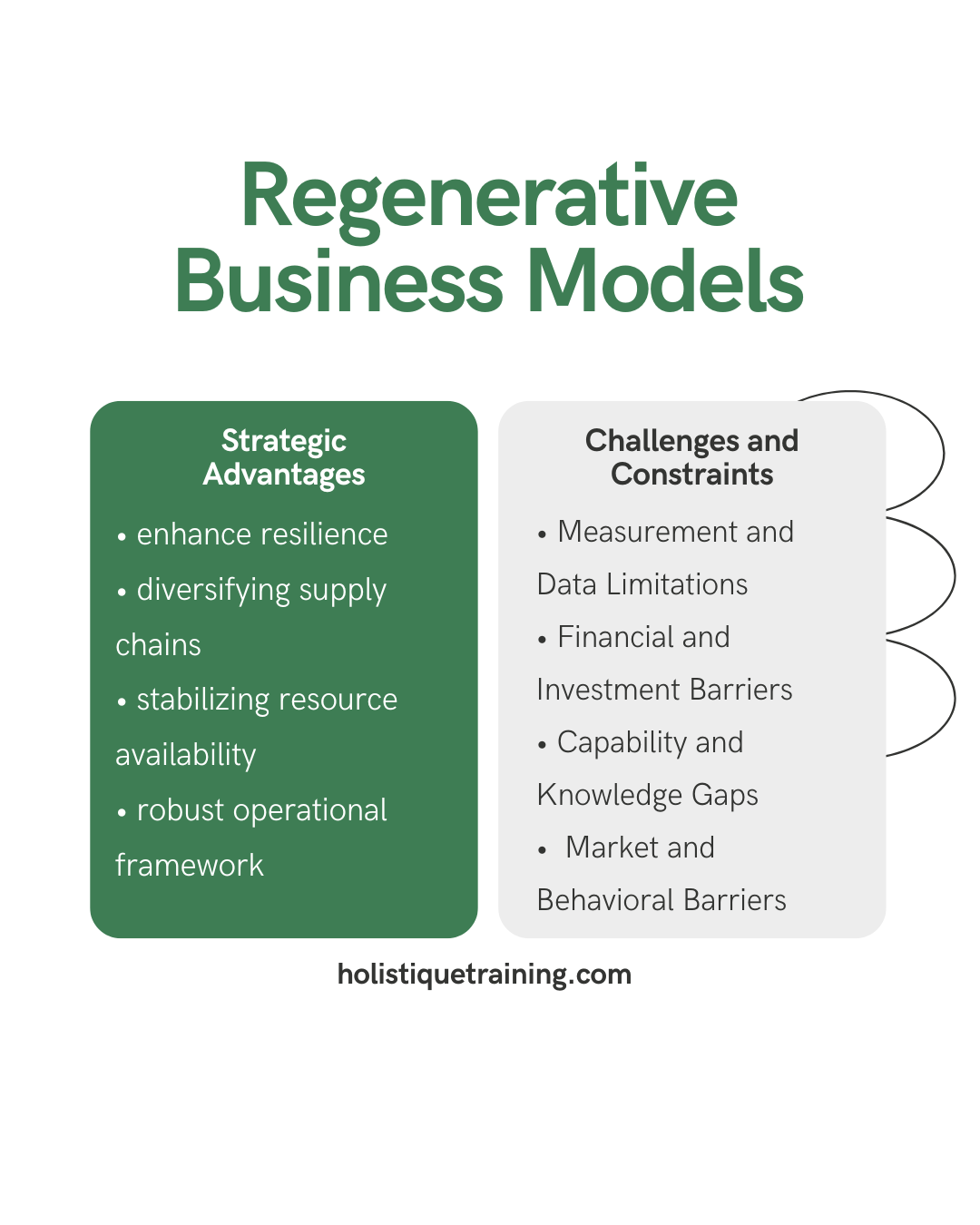
8- Future Outlook: Toward Regenerative Economies

9- Conclusion
Regenerative business models represent a fundamental redefinition of value creation, moving beyond sustainability to actively restore ecosystems and strengthen communities. They offer a pathway for aligning profitability with long-term resilience, addressing both environmental and economic challenges simultaneously. The evidence demonstrates that regeneration is not only necessary but viable, providing organizations with a strategic advantage in an increasingly complex global environment. The critical question is no longer whether regeneration should be adopted, but how quickly it can be implemented at scale.